Introduction to 111.90.150.504 and Its Online Relevance
The keyword 111.90.150.504 appears at first glance to be a standard Internet Protocol (IP) address, a format commonly used to identify devices connected to the internet. In today’s digital world, IP addresses are essential for communication between servers, websites, and user devices. Every action online, from opening a webpage to sending an email, relies on these numerical identifiers to ensure that data reaches the correct destination. Because of this, any string that resembles an IP address naturally attracts attention and curiosity.
However, not every number formatted like an IP address is valid. The string 111.90.150.504 has gained traction in search engines and online discussions, often leaving users confused about its meaning, origin, and potential risks. Some users search it to identify a location, while others suspect it may be linked to suspicious activity, server logs, or unknown network behavior. This article explores the concept in depth, explaining what the keyword represents, how IP addresses function, and why this particular string continues to appear in digital spaces.
Understanding such technical details is important not only for IT professionals but also for everyday users who want to stay informed about online privacy, cybersecurity, and internet infrastructure. By breaking down the structure and context of 111.90.150.504, this article provides a clear, trustworthy, and comprehensive explanation rooted in real networking principles.
What Is an IP Address and How It Works
An IP address, or Internet Protocol address, is a unique numerical label assigned to each device connected to a network that uses the Internet Protocol for communication. These addresses act like digital identifiers, allowing computers, smartphones, servers, and other devices to locate and communicate with each other across the internet. Without IP addresses, the internet would not function as we know it today.
There are two primary types of IP addresses in use: IPv4 and IPv6. IPv4 is the older and more widely recognized format, consisting of four numbers separated by dots. Each number, known as an octet, ranges from 0 to 255. For example, an address like 111.90.150.504 is a valid IPv4 address because it follows this structure. IPv6, on the other hand, was introduced to handle the growing number of devices online and uses a longer, more complex format with hexadecimal values.
When you visit a website, your device sends a request to a server using its IP address. The server then responds with the requested data, such as a webpage or file. This entire process happens in milliseconds, powered by the structured system of IP addressing. Because of this, accuracy in IP formatting is critical. Even a small deviation from the standard format can render an address unusable.
Why 111.90.150.504 Is Not a Valid IP Address
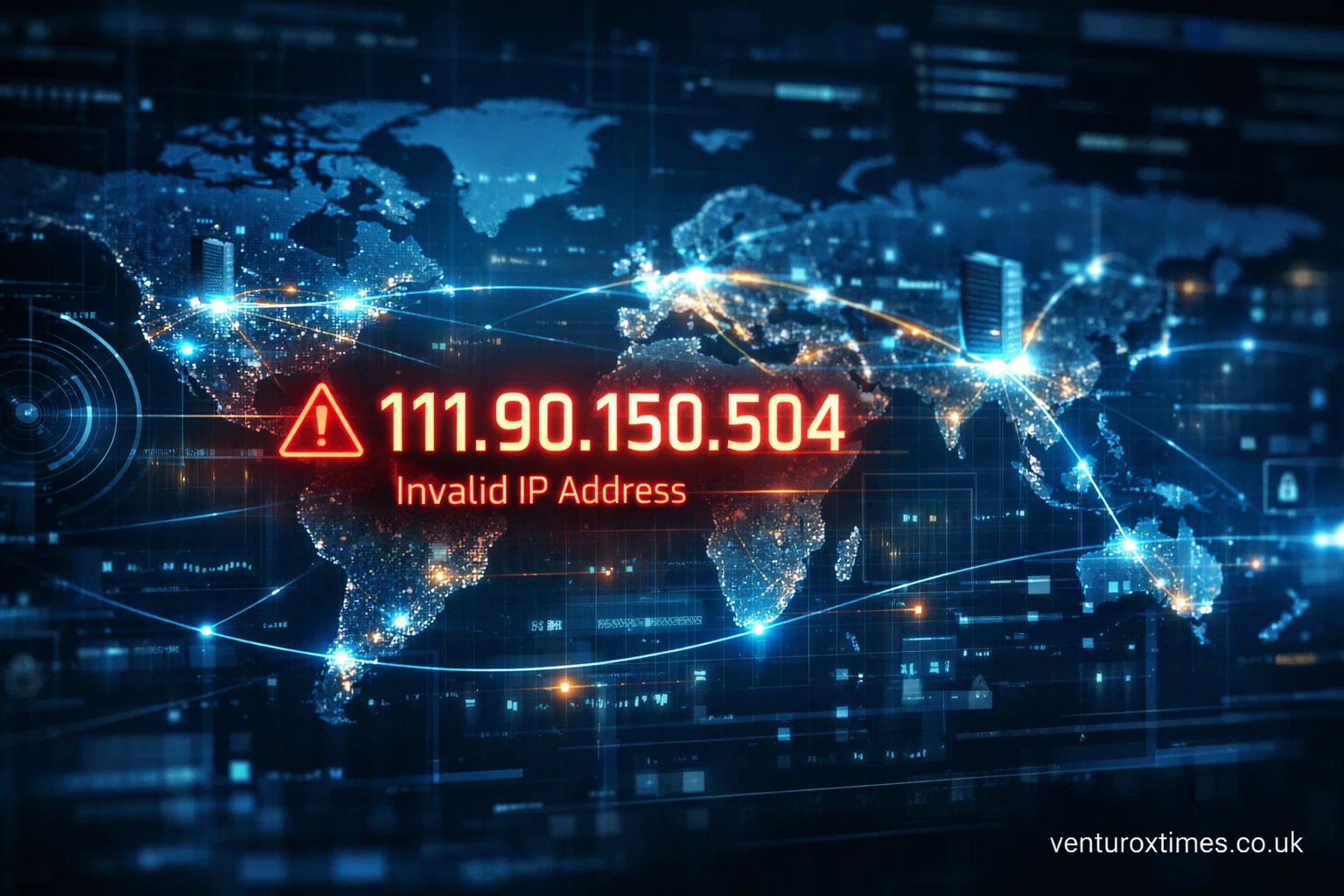
At a technical level, 111.90.150.504 does not qualify as a valid IPv4 address. The reason lies in the final segment, or octet, which is 504. In IPv4 addressing, each octet must fall within the range of 0 to 255. Any number outside this range violates the rules of the protocol, making the address invalid for real-world networking purposes.
This limitation exists because each octet represents an 8-bit binary number. The maximum value that can be stored in 8 bits is 255. Therefore, a number like 504 cannot be encoded within a single octet, and the system will not recognize it as a legitimate address. As a result, routers, servers, and networking tools will reject such a format.
Despite this, the string continues to appear in various places online. This often leads users to believe it is a real address that can be traced or analyzed. In reality, it is more likely the result of a formatting error, a logging issue, or a misunderstanding of how IP addresses work. Recognizing this distinction is crucial for avoiding confusion and misinterpretation.
Common Reasons This Keyword Appears Online
There are several reasons why 111.90.150.504 shows up in search results, forums, and technical discussions. One of the most common causes is data logging errors. When servers or applications record network activity, they may occasionally capture incomplete or corrupted data. These anomalies can produce strings that resemble IP addresses but do not follow valid formatting rules.
Another reason is automated content generation. Some websites use scripts or bots to collect and publish data from various sources. If these systems do not properly validate the information they gather, they may include invalid IP-like strings in their content. Once published, search engines index these pages, making the keyword visible to a wider audience.
User curiosity also plays a role. When people encounter unusual numbers in logs or analytics tools, they often search for them online. This repeated searching increases the keyword’s visibility and encourages content creators to write about it, further amplifying its presence. Over time, the keyword gains traction despite lacking technical validity.
Understanding Valid IP Address Structures
To better understand why 111.90.150.504 is invalid, it helps to examine what a proper IP address looks like. A valid IPv4 address consists of four octets separated by dots, with each octet ranging from 0 to 255. This structure ensures compatibility with networking protocols and allows devices to communicate effectively.
Each octet represents a portion of the address in binary form. Together, the four octets create a 32-bit number that uniquely identifies a device on a network. This system allows for over four billion possible addresses, although many are reserved for specific purposes such as private networks or special functions.
IPv6 addresses, while more complex, follow their own strict formatting rules. They use eight groups of hexadecimal numbers separated by colons and provide a vastly larger pool of addresses. However, the string 111.90.150.504 clearly attempts to follow the IPv4 format, making its invalidity even more apparent due to the out-of-range value in the final segment.
IP Geolocation and Real Address Tracking
One of the main reasons people search for IP addresses is to determine their location. IP geolocation tools can provide approximate information about where an address is registered, including the country, region, and internet service provider. This information is useful for network management, cybersecurity, and digital marketing.
For a valid IP address, geolocation databases use publicly available registration data and routing information to identify its origin. This does not reveal the exact physical location of a user but provides a general idea of where the network is based. Businesses often use this data to tailor content, detect fraud, or analyze user behavior.
However, an invalid address like 111.90.150.504 cannot be traced using these tools. Since it does not exist within the standard IP addressing system, there is no corresponding data in geolocation databases. Any attempt to look it up will either result in an error or return no meaningful information.
Security Implications and Misconceptions
IP addresses are often associated with cybersecurity, leading some users to worry when they encounter unfamiliar ones. While it is true that IP addresses can be used to track suspicious activity or identify potential threats, not every unusual string represents a security risk.
In the case of 111.90.150.504, the primary issue is not malicious intent but invalid formatting. Security tools rely on accurate data to detect and respond to threats. An address that does not conform to standard rules cannot be analyzed in the same way as a valid one, making it irrelevant for most security assessments.
Misinterpretations can lead to unnecessary concern. Users may assume that any unknown IP-like string is linked to hacking, malware, or unauthorized access. In reality, many such strings are harmless artifacts of logging errors or data processing issues. Understanding the difference between valid and invalid addresses helps prevent confusion and promotes informed decision-making.
How to Handle Unusual IP-Like Strings
When encountering a string like 111.90.150.504 in logs or analytics tools, the first step is to verify its format. Checking whether each segment falls within the valid range can quickly determine whether it is a real IP address. If it is not, it can usually be disregarded as an error or artifact.
For valid addresses, further investigation may be necessary. This can include using IP lookup tools, checking server logs for patterns, and consulting network administrators if needed. Accurate interpretation of data is essential for effective troubleshooting and security monitoring.
It is also important to ensure that systems and applications are properly configured to validate IP addresses. Implementing input validation and error handling can prevent malformed data from appearing in logs and reports. This not only improves data quality but also reduces confusion for users analyzing the information.
The Role of Search Engines and SEO Trends
Search engines play a significant role in the visibility of keywords like 111.90.150.504. When users repeatedly search for a specific term, search engines recognize it as relevant and include it in their indexing and ranking algorithms. This creates a feedback loop where increased visibility leads to more searches, and more searches lead to even greater visibility.
Content creators often respond to these trends by producing articles that address user queries. Even if the keyword is technically invalid, its popularity makes it a valuable topic for SEO. By providing accurate and informative content, writers can help users understand the context and avoid misinformation.
This dynamic highlights the importance of authoritative and trustworthy content. Articles that explain technical concepts clearly and accurately contribute to a better online experience, helping users navigate complex topics with confidence.
Conclusion: The Reality Behind 111.90.150.504
The keyword 111.90.150.504 may look like a standard IP address, but it does not meet the requirements of a valid IPv4 format. Its presence online is the result of data errors, automated content generation, and user curiosity rather than actual network usage. Understanding this distinction is essential for interpreting such strings correctly.
IP addresses remain a fundamental part of internet communication, enabling devices to connect and exchange information efficiently. By learning how they are structured and validated, users can better understand the digital systems they interact with ყოველდღy. This knowledge also helps in identifying errors, avoiding misconceptions, and making informed decisions بشأن online security and data analysis.
Ultimately, 111.90.150.504 serves as a reminder that not everything that looks technical is meaningful. With the right knowledge and approach, anyone can distinguish between valid information and anomalies, ensuring a clearer and more confident understanding of the digital world.